Smart Meal Planning
Build Your Smart Meal Plan
Create a practical meal plan around your food preferences, routine, cooking time and budget.
Your Personalized Plan
Your Smart Meal Plan
A practical meal plan built around your preferences.
Plan Overview
Your Meal Schedule
Smart Grocery List
A combined shopping list based on your generated meals.
Meal Prep Tips
“What should I cook today?”
It sounds like a simple question. But when you have to answer it every morning, afternoon and evening, meal decisions can become surprisingly tiring.
You may have vegetables in the fridge but no idea what to make with them. On another day, you may decide on a meal only to discover that an important ingredient is missing. Add work, studies, family responsibilities and grocery shopping, and planning food can easily become another daily task.
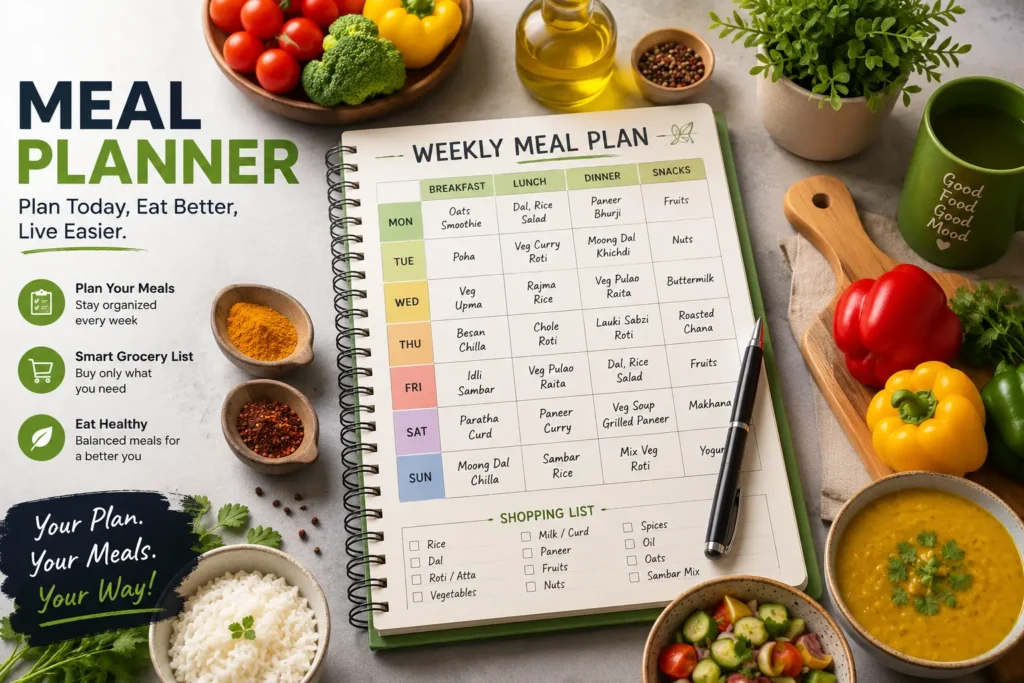
A meal planner gives you a simpler way to handle this.
Instead of deciding every meal at the last minute, you plan some of your meals ahead of time. You know what you intend to prepare, what ingredients you already have and what you may need to buy.
You do not need a complicated diet chart to begin. A simple weekly meal plan can be enough.
If you would rather not start with a blank page, try our Smart Meal Planner to get a starting plan that you can review and adjust around your routine.
What Is a Meal Planner?
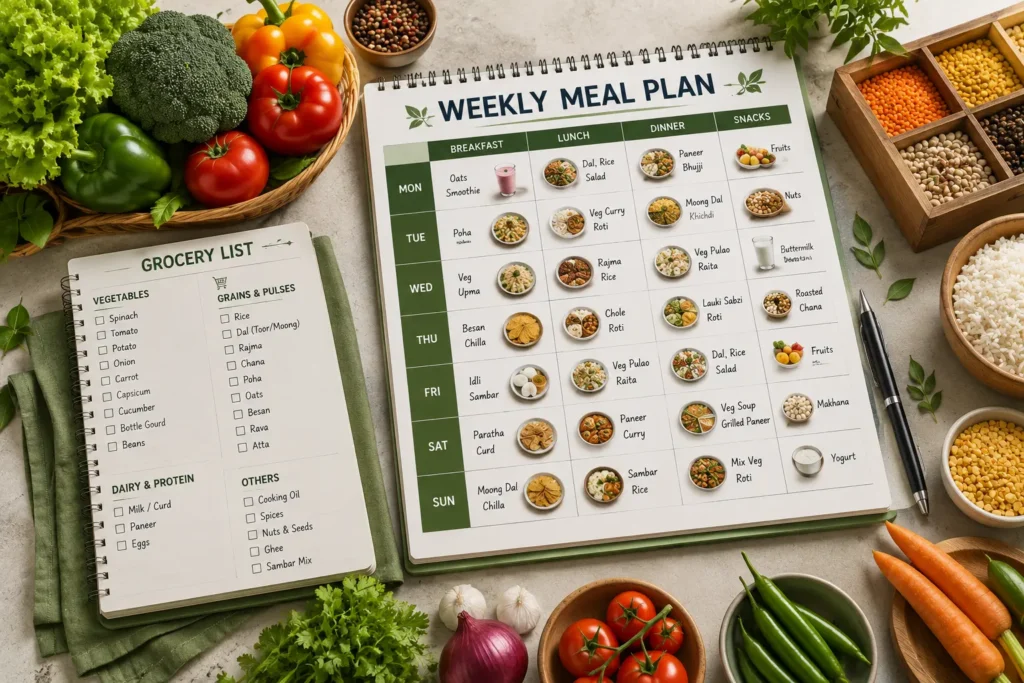
A meal planner is a tool or simple system for organizing meals in advance.
You might use it to plan:
- breakfast
- lunch
- dinner
- snacks
- ingredients to buy
- basic meal-preparation notes
Some people plan an entire week. Others prefer to plan only three or four days at a time.
Both approaches are fine.
The purpose of meal planning is not to create a perfect eating schedule. It is to reduce the number of food decisions you have to make at the last minute.
Think about how you use a calendar.
You do not keep every meeting, appointment and deadline in your head. You write them down so that your week is easier to manage.
A weekly meal planner applies the same basic idea to your meals.
Why Is Meal Planning Useful?
The biggest advantage of meal planning is simple: you decide earlier.
Imagine coming home after a busy day.
Without a plan, you may need to decide what to cook, check the kitchen, find a recipe and see whether all the ingredients are available.
If you have already planned dinner, much of that thinking has been done.
Of course, plans sometimes change. But having a starting point is usually easier than making every decision from scratch.
Grocery Shopping Becomes More Organized
Meal planning can also give your grocery shopping more direction.
Instead of buying ingredients first and deciding what to cook later, you can reverse the process:
Plan your meals → check your kitchen → identify what is missing → create your grocery list.
For example, if you plan dal, rice and a vegetable dish for one evening, you can check whether you already have rice and dal before adding anything to your shopping list.
This makes the list more connected to meals you actually intend to prepare.
You Can Use Ingredients More Thoughtfully
Planning ahead can also help you notice where the same ingredient can be used more than once.
Suppose you need spinach for one meal.
Rather than buying it for a single recipe and forgetting about the remainder, you could plan another suitable dish later in the week that uses the same ingredient.
Meal planning cannot guarantee that there will be no food waste, but it can help you think about ingredients before purchasing more.
Meal Planning Is Not the Same as a Medical Diet
This is an important distinction.
A meal planner is primarily an organizational tool. A general online meal planner should not be treated as a personalized medical diet.
There is no single menu that is suitable for everyone.
Age, lifestyle, physical activity, cultural preferences, locally available foods and individual circumstances can all affect what an appropriate diet looks like.
The World Health Organization explains that healthy diets can take different forms and describes four core principles: adequacy, balance, moderation and diversity.
That is why a practical meal plan should be flexible.
Your goal is not to copy somebody else’s “perfect diet.” It is to organize meals in a way that makes sense for your own routine and circumstances.
How to Plan Meals for the Week
If you are new to meal planning, do not make your first weekly plan unnecessarily complicated.
Start with food you already know and a schedule you can realistically follow.
1. Look at Your Schedule First
Before choosing meals, look at the week ahead.
Ask yourself:
- Which days will be busiest?
- When will I have time to cook?
- Will I eat lunch at home, college or work?
- Are there days when I need something quick?
- Do I already have plans to eat outside?
This helps you avoid planning a time-consuming meal on the day when you have the least time available.
2. Start With Familiar Meals
You do not need seven new recipes simply because you have started meal planning.
In fact, filling your first weekly meal plan with unfamiliar dishes can create more work rather than less.
Start with meals you already enjoy and know how to prepare.
If you want more variety, add one or two new ideas during the week.
3. Check What You Already Have
Before creating a grocery list, look through your refrigerator, freezer and pantry.
You may already have rice, atta, dal, vegetables, spices, eggs or other ingredients that can be used during the week.
Build part of your plan around what is already available.
4. Keep Your Plan Flexible
Real life does not always follow a schedule.
Maybe Wednesday becomes unexpectedly busy. Perhaps an ingredient is unavailable. Maybe you simply do not feel like eating the meal you originally planned.
Change it.
Swap Wednesday’s dinner with Thursday’s.
Move a meal to the weekend.
A useful meal plan should make your week easier, not make you feel that you have failed because you changed the schedule.
What Should You Consider When Planning Your Meals?
Meal planning should begin with practicality.
Consider the foods you normally eat, your available cooking time, your budget and what ingredients are easy to find where you live.
Variety also matters.
Rather than repeatedly planning the same few foods, think about including different foods that are appropriate for your preferences and circumstances.
For general healthy-eating information, use reliable sources rather than social-media trends or extreme diet claims.
The World Health Organization’s healthy diet guidance is a useful starting point for understanding general principles of healthy eating.
If you need a diet for a medical condition or have specialized nutritional requirements, however, general online information is not enough. Seek individualized guidance from an appropriately qualified healthcare professional or dietitian.
Can You Use a Meal Planner for Indian Food?
Absolutely.
Meal planning is a method of organization, not a specific cuisine.
You do not need to replace familiar Indian meals with unusual “diet foods” simply because you are using a weekly meal planner.
India also has enormous regional food diversity. A normal meal in West Bengal can look very different from one in Punjab, Gujarat, Maharashtra, Kerala or Tamil Nadu.
Depending on your household, preferences and individual requirements, your meals might include familiar foods such as rice, roti, dal, pulses, seasonal vegetables, fruits, curd, paneer, eggs, fish or other foods you normally consume.
The point is not to create one universal Indian meal plan.
The better approach is to plan around your food, your routine and ingredients that are realistically available to you.
How to Use Our Smart Meal Planner
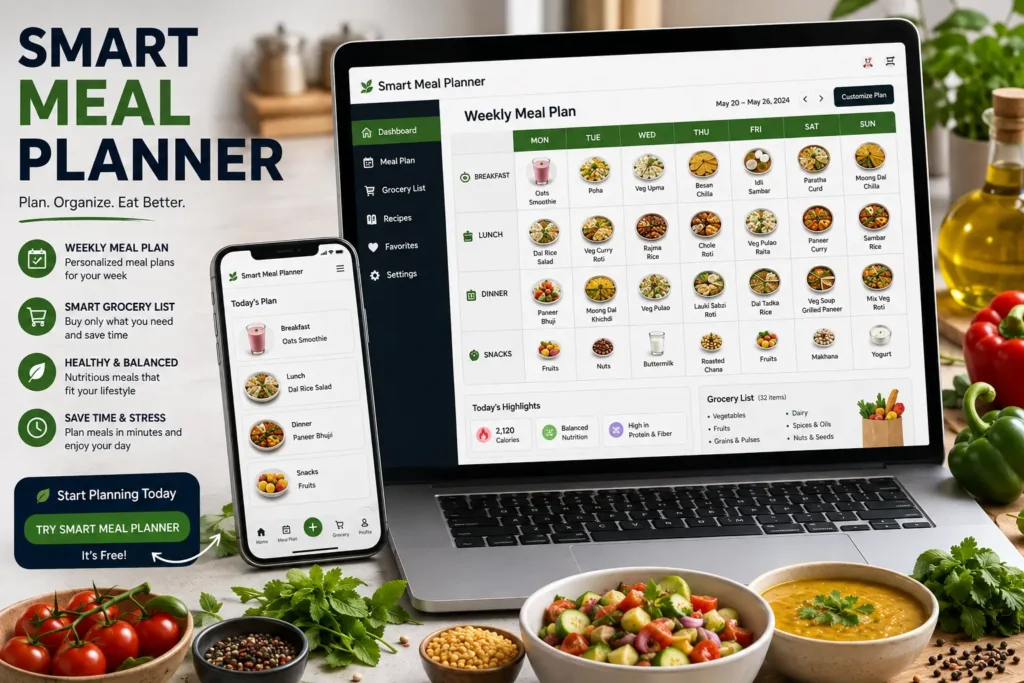
If creating a weekly meal plan manually feels like too much work, our Smart Meal Planner can give you a starting point.
Step 1: Choose Your Preferences
Open the Smart Meal Planner and review the available options.
Choose the settings that best reflect what you actually want.
Step 2: Generate Your Plan
Once you have selected your preferences, generate your meal suggestions.
You now have something concrete to work with instead of starting from an empty page.
Step 3: Review the Suggestions
Do not automatically follow every generated suggestion.
Read through the plan and ask:
- Do I eat these foods?
- Are the ingredients available to me?
- Can I prepare these meals with the time I have?
- Does anything need to be replaced?
- Does the plan fit my actual routine?
Automated tools work best when you combine their suggestions with your own judgment.
Step 4: Make It Your Own
Replace meals that do not suit you.
Move meals between days.
Use ingredients that are more easily available locally.
The generated plan is a starting point. The final plan should belong to you.
A Simple Weekly Meal Planning Example
Suppose Monday and Tuesday are your busiest workdays.
Those probably are not the best evenings to experiment with complicated recipes.
You could plan familiar, easier meals for those days.
Wednesday may give you more cooking time, so you could prepare something that also provides ingredients or preparation for Thursday.
By Friday, you could look at what remains in the refrigerator and plan accordingly.
The weekend may be more flexible.
Notice that this approach does not require an elaborate diet chart.
It simply matches the difficulty of your meals to the reality of your schedule.
That is what makes meal planning practical.
Can AI Help You Find Meal Ideas?
AI can be useful when you need ideas.
For example, suppose you have paneer, tomatoes and a few vegetables available but cannot decide what to make.
You could ask an AI assistant to suggest several simple meal ideas using those ingredients.
Clear instructions usually make AI outputs more useful.
If you are unsure how to structure those instructions, our Free AI Prompt Generator can help you create prompts for different tasks.
You can also browse our AI Prompt Library for ready-to-use prompt ideas.
Remember that AI-generated nutrition information can be inaccurate or unsuitable for an individual’s circumstances. Use AI for brainstorming and organization rather than treating its output as professional medical or nutritional advice.
Common Meal Planning Mistakes to Avoid
Trying to Change Everything at Once
Your first week does not need to completely change the way you eat.
Start with familiar meals and improve your planning gradually.
Planning Without Checking Your Kitchen
Always check what you already have before shopping.
This can prevent you from unnecessarily buying ingredients that are already sitting in your pantry or refrigerator.
Making Every Meal Complicated
Not every dinner needs to be a new recipe.
Simple meals have an important place in a realistic weekly meal plan.
Creating a Plan That Is Too Rigid
Your schedule will occasionally change.
Your meal plan should be able to change with it.
Using a General Planner for Medical Nutrition
An online meal planning tool cannot assess your complete medical history or nutritional needs.
People with medical conditions, significant food allergies, pregnancy-related nutritional requirements or other specialized dietary needs should seek appropriate professional guidance.
Meal Planning for Beginners: Start Small
You do not have to begin by planning an entire month.
Try planning three days.
If that feels comfortable, move to a full week.
At the end of the week, ask yourself:
- Which meals were easy to prepare?
- Which ones took too much time?
- What ingredients were left unused?
- Which meals did I actually enjoy?
- What would make next week easier?
Your answers will help you create a better plan next time.
Meal planning becomes more useful when you treat it as a system that can improve rather than a schedule that must be perfect.
Frequently Asked Questions
Conclusion: Keep Meal Planning Simple
Meal planning does not have to mean complicated recipes, strict schedules or spending hours preparing food every weekend.
At its core, it is simply about making some decisions before you become busy or hungry.
Look at your week.
Choose meals you actually enjoy.
Check what you already have.
Shop for what you genuinely need.
And leave enough flexibility for real life.
Your first weekly meal plan does not have to be perfect. It just needs to make the next few days a little easier.
If you do not want to begin with an empty page, try our Smart Meal Planner and use the generated suggestions as a starting point for your own weekly plan.
Start planning your meals today with the Smart Meal Planner.