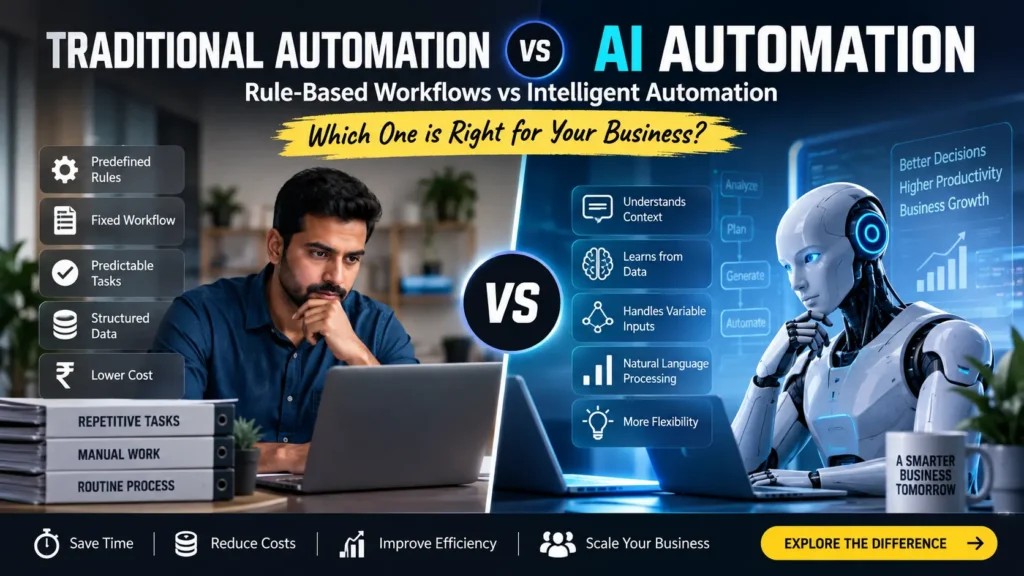
Aaj ke digital business environment mein automation sirf large companies ke liye important nahi raha. Small businesses, startups, restaurants, hotels, agencies, e-commerce stores aur service providers bhi repetitive tasks ko automate karke time aur operational cost reduce kar sakte hain.
Automation ko samajhne se pehle Artificial Intelligence ka basic concept samajhna bhi important hai
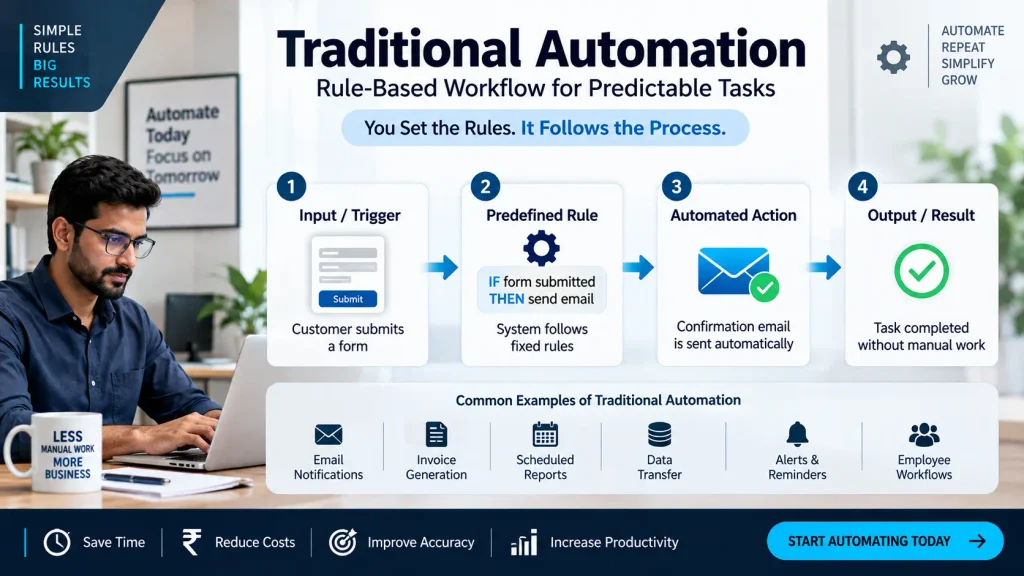
Traditional automation ek rule-based automation system hai jahan software predefined instructions ke according task perform karta hai.
Simple language mein:
Agar X hota hai, toh Y karo.
Ismein system generally khud se decision nahi banata. Jo rules developer ya business owner ne set kiye hain, system unhi rules ke according kaam karta hai.
Example
Suppose ek business ko website par customer inquiry receive hoti hai.
Workflow:
Customer Form Submit → Data Save → Confirmation Email → Sales Team Notification
Yeh traditional automation ka simple example hai.
Agar customer form submit nahi karta, workflow start nahi hoga.
Traditional Automation Examples
Automatic email confirmation
Invoice generation
Scheduled reports
Form-to-spreadsheet automation
Automatic notifications
Employee attendance rules
Order status updates
Scheduled social media posting
Data transfer between software
Basic CRM workflows
Traditional automation especially un tasks ke liye useful hai jahan rules predictable aur clearly defined hain.
Business automation ka broader concept samajhne ke liye aap hamara complete AI in Business Automation guide bhi read kar sakte hain.
2. AI Automation Kya Hai?
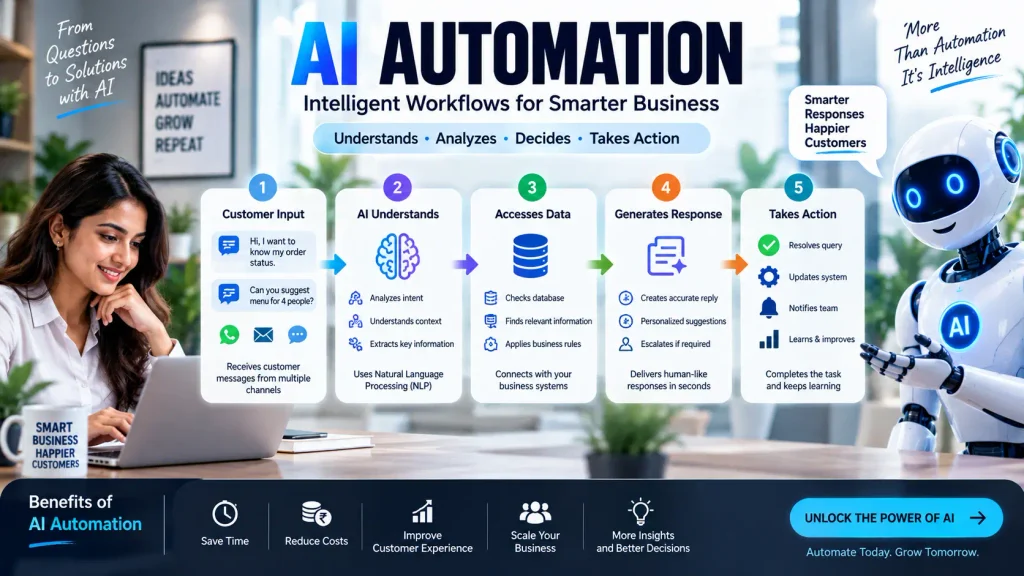
AI automation mein automation ke saath Artificial Intelligence ka use hota hai.
AI systems large amounts of information ko process karke patterns identify kar sakte hain aur natural language ya other data formats ko interpret kar sakte hain.
Simple language mein:
AI automation sirf predefined rules execute nahi karta; kuch situations mein information ko interpret karke appropriate action select ya generate kar sakta hai.
Customer writes: “Mera order kal se nahi aaya aur mujhe urgently chahiye.”
AI customer ke message ka intent identify kar sakta hai, relevant order information retrieve kar sakta hai aur predefined business policies ke according response generate kar sakta hai.
AI Automation Examples
AI customer support
AI email classification
AI lead qualification
AI document processing
AI invoice data extraction
AI content generation
AI meeting summarization
AI sales assistance
AI chatbot
AI-powered business reporting
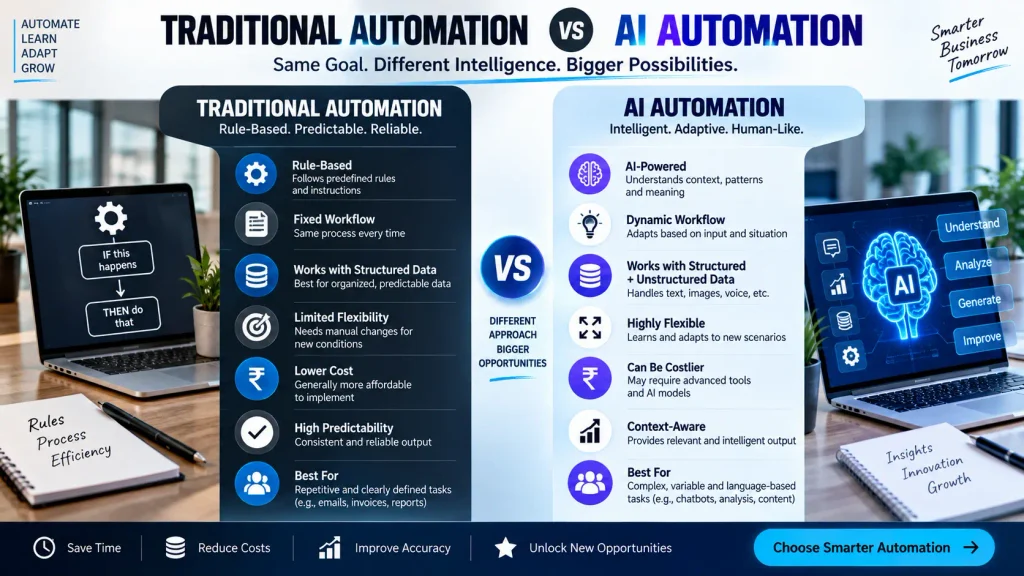
3. Traditional Automation vs AI Automation: Main Difference
Sabse important difference rules vs intelligence/context processing ka hai.
Feature
Traditional Automation
AI Automation
Basic approach
Rule-based
AI/data-driven
Decision making
Predefined rules
Context/data ke basis par
Flexibility
Limited
Generally higher
Structured data
Excellent
Excellent
Unstructured data
Limited
Stronger
Natural language
Limited
Strong
Predictability
High
Depends on AI system
Setup
Usually simpler
Usually more complex
Maintenance
Rule changes required
Model/prompt/data/system management may be required
Best for
Repetitive predictable tasks
Complex or variable tasks
Human-like interaction
Limited
Possible
Learning/adaptation
Usually no
Some AI systems can adapt through configured data/workflows
Cost
Often lower
Can be higher
Error type
Rule/configuration errors
AI interpretation/model errors
Important: AI automation traditional automation ko completely replace nahi karta. Real-world businesses mein dono systems ko combine karna often practical hota hai.
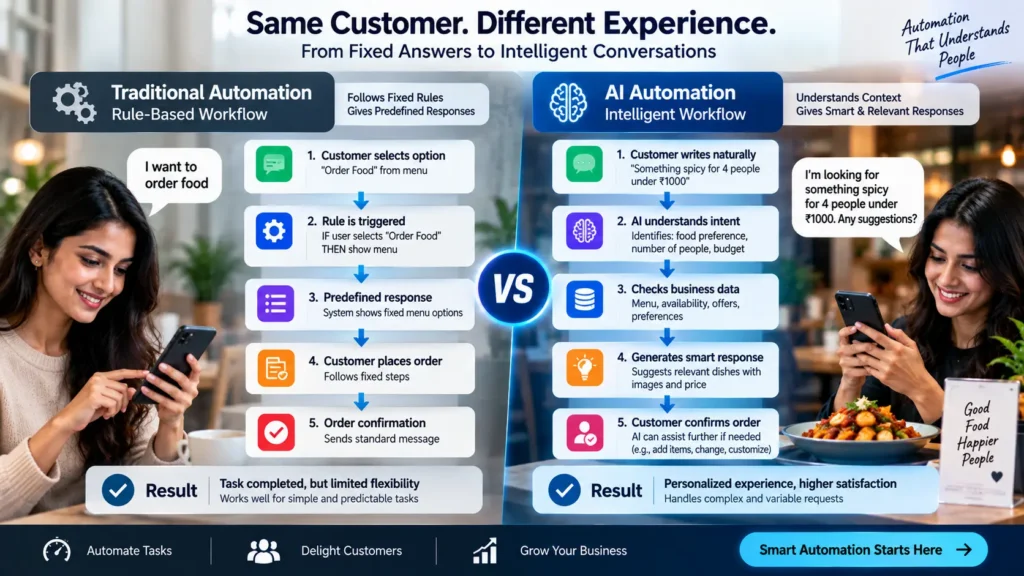
4. Rule-Based Automation vs AI: Simple Example
Suppose a restaurant receives customer messages.
Traditional Automation
Customer selects:
1 → Menu
System sends:
“Here is our menu.”
Customer selects:
2 → Delivery
System sends:
“Please enter your delivery address.”
Yahan system fixed options aur rules follow kar raha hai.
AI Automation
Customer writes:
“Bhai, 4 log ke liye kuch spicy aur budget mein recommend karo.”
AI customer ke natural-language request ko interpret karke relevant menu items suggest kar sakta hai.
Yahan customer ko predefined button select karna zaroori nahi hai.
5. Rule-Based Workflow Examples
Traditional automation ka biggest strength hai predictability.
Agar business process clearly defined hai, traditional automation highly useful ho sakta hai.
Example 1: Invoice Automation
Order Completed
↓
Invoice Generate
↓
Invoice Email
↓
Accounting System Update
↓
Customer Notification
Har step predefined hai.
Example 2: Employee Attendance
Employee checks in
↓
System records time.
↓
If late:
Late Status = Yes
↓
Manager notification.
Yeh ek straightforward rule-based workflow hai.
Example 3: Lead Form
Customer website form submit karta hai.
Rule:
If form submitted → create CRM lead
Then:
Send confirmation email
Then:
Notify salesperson
Is type ke workflow mein AI ki zaroorat necessarily nahi hoti.
6. AI-Based Workflow Examples
AI automation tab useful ho sakta hai jab input variable, unstructured ya natural language based ho.
Example 1: AI Customer Support
Customer message:
“Mera order abhi tak deliver nahi hua aur mujhe kal event ke liye chahiye.”
AI workflow:
Customer Message
↓
Understand Intent
↓
Find Order Information
↓
Check Delivery Status
↓
Generate Response
↓
Escalate if Required
Yeh traditional fixed-button workflow se considerably different hai.
Jab AI system tools use karke decisions leta hai aur multiple steps complete karta hai, tab concept AI agents ki taraf move karta hai.
Example 2: AI Lead Qualification
Customer:
“Mujhe apne restaurant ke liye 20-table POS system chahiye. Next month setup karna hai.”
AI system potentially identify kar sakta hai:
Business type
Requirement
Approximate scale
Timeline
Purchase intent
Then CRM mein lead ko relevant category mein place kiya ja sakta hai.
7. Traditional Automation vs AI Automation: Cost Comparison
Cost comparison karte waqt sirf software subscription dekhna enough nahi hai.
Total cost mein include ho sakta hai:
Software
API usage
Development
Integration
Maintenance
Training
Monitoring
Human review
Data management
Traditional Automation Cost
Traditional automation generally predictable workflows ke liye relatively straightforward ho sakta hai.
For example:
Form → Spreadsheet → Email
Is workflow ko automate karne ke liye complex AI processing ki zaroorat nahi hai.
AI Automation Cost
AI automation mein additional costs ho sakte hain:
AI model/API usage
Data processing
Integration
Prompt/workflow design
Monitoring
Human review
AI-specific maintenance
Isliye AI automation ka cost use case ke according significantly vary kar sakta hai.
Important Business Rule
Har task ko AI se automate karna cost-effective nahi hota.
Agar ek simple rule-based workflow 100% predictable hai, toh unnecessary AI layer add karna business ke liye extra complexity create kar sakta hai.
8. Accuracy and Flexibility
Yeh traditional automation aur AI automation ka ek important comparison point hai.
Traditional Automation
Traditional systems fixed rules follow karte hain.
System har baar same condition ko same way process karega.
AI Automation
AI systems context aur input variations ko handle kar sakte hain.
Lekin AI output probabilistic ho sakta hai aur errors possible hain.
For example, customer ka message ambiguous ho:
“Mera previous wala order phir se bhej do.”
AI ko context identify karna padega.
Aise situations mein business ko human escalation ya validation rules ki zaroorat ho sakti hai.
9. Traditional Automation Kab Use Karna Chahiye?
Traditional automation suitable ho sakta hai jab:
Process predictable ho
Rules clearly defined hon
Input structured ho
Same action repeatedly perform karna ho
Compliance requirements strict hon
Exact output required ho
AI ki interpretation ki zaroorat na ho
Examples
Payroll calculations
Scheduled reports
Basic notifications
Invoice workflows
Data synchronization
Order status updates
Form processing
10. AI Automation Kab Use Karna Chahiye?
AI automation useful ho sakta hai jab:
Customer input unpredictable ho
Natural language involved ho
Large documents process karne hon
Emails classify karne hon
Customer intent understand karna ho
Data se insights extract karne hon
Content generate karna ho
Complex information summarize karni ho
Examples
AI customer service
AI sales assistant
Email classification
Document analysis
Lead qualification
AI content workflows
Meeting summarization
Agar aap AI ko professionally learn karke AI-related career opportunities explore karna chahte hain, toh hamari AI Career Starter Series 2026 bhi useful starting point ho sakti hai.
11. Kaunsa Business Model Kis Automation Ke Liye Suitable Hai?
Har business ke liye same automation strategy suitable nahi hoti.
Small Business
Small businesses commonly start with simple automation.
Examples:
Appointment reminders
Invoice generation
Customer notifications
Lead collection
Email automation
Initially traditional automation enough ho sakta hai.
Later AI add kiya ja sakta hai.
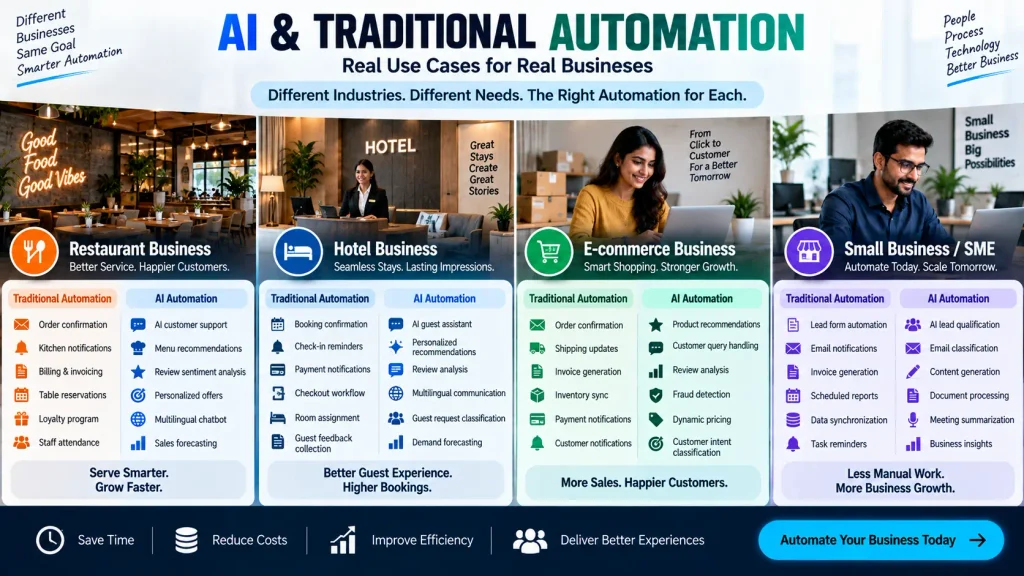
E-commerce Business
E-commerce businesses hybrid automation use kar sakte hain.
Traditional
Order confirmation
Payment notification
Shipping update
Invoice
AI
Product recommendations
Customer query handling
Review analysis
Customer intent classification
Restaurant Business
Restaurant mein:
Traditional Automation
Order confirmation
Kitchen notifications
Billing
Reservation confirmation
Loyalty points
AI Automation
Customer recommendations
AI chatbot
Review sentiment analysis
Personalized offers
Customer query understanding
Hotel Business
Hotels mein:
Traditional
Booking confirmation
Check-in reminders
Payment notifications
Checkout workflow
AI
Guest query assistant
Personalized recommendations
Review analysis
Multilingual communication
Guest-request classification
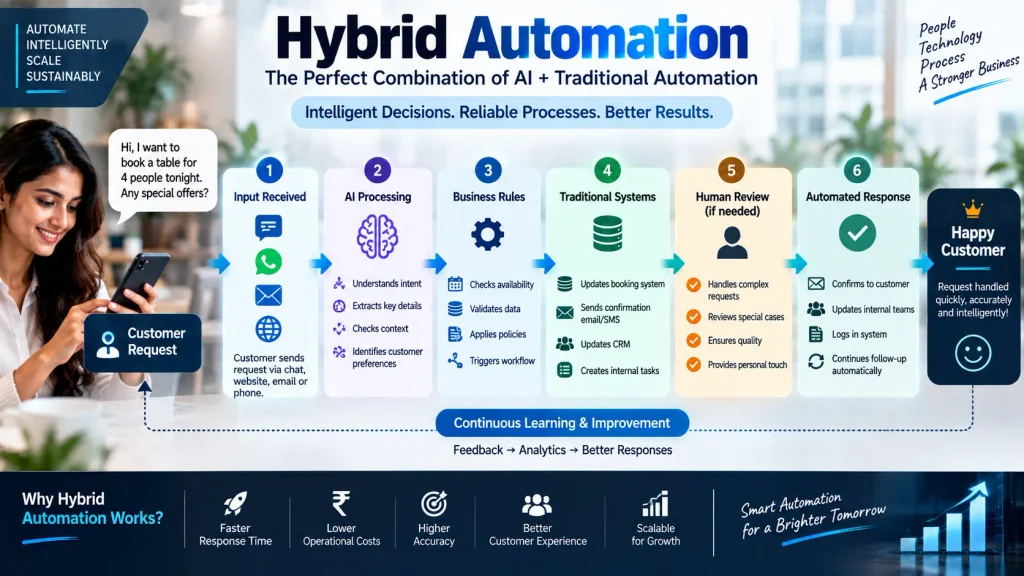
12. Hybrid Automation: Traditional + AI
Modern businesses ke liye ek important concept hai:
AI vs traditional automation ko always either/or decision ke roop mein nahi dekhna chahiye.
Kai workflows mein hybrid automation more practical ho sakta hai.
Example: Hotel Customer Support
Customer Message
↓
AI understands request
↓
Traditional system checks booking database
↓
AI generates response
↓
Rule checks whether escalation is required
↓
Human employee handles complex issue
Yahan AI aur traditional automation dono apna-apna role perform kar rahe hain.
13. Traditional Automation vs AI Automation Comparison Table
Business Requirement
Traditional Automation
AI Automation
Fixed repetitive task
✅ Excellent
⚠️ May be unnecessary
Simple notifications
✅ Excellent
⚠️ Usually unnecessary
Structured data processing
✅ Strong
✅ Strong
Natural-language queries
❌ Limited
✅ Stronger
Customer conversations
⚠️ Limited
✅ Suitable
Document understanding
⚠️ Limited
✅ Suitable
Predictable workflow
✅ Excellent
⚠️ May add complexity
Variable inputs
❌ Limited
✅ Better suited
Exact predefined output
✅ Strong
⚠️ Needs validation
Content generation
❌ Not designed for it
✅ Strong use case
Lead qualification
⚠️ Rule-based possible
✅ Context-based possible
Cost predictability
Generally high
Can vary
Implementation complexity
Generally lower
Generally higher
Human escalation
Rule-triggered
Often context/risk-based
14. Traditional Automation vs AI Automation: Which One Should Your Business Choose?
Iska answer business ke process par depend karta hai.
Instead of asking:
“AI automation better hai ya traditional automation?”
Business owners ko yeh question poochna chahiye:
“Mere process ke liye kaunsi automation technology appropriate hai?”
Simple Decision Framework
Step 1: Process identify kijiye.
Step 2: Check kijiye ki process predictable hai ya variable.
Step 3: Agar fixed rules hain → traditional automation consider kijiye.
Step 4: Agar natural language/context required hai → AI automation consider kijiye.
Step 5: Agar dono required hain → hybrid automation consider kijiye.
Step 6: Cost, accuracy, security aur human oversight evaluate kijiye.
15. AI Automation Implement Karne Se Pehle 5 Questions
Business owners ko AI automation implement karne se pehle yeh questions consider karne chahiye:
1. Kya task genuinely repetitive hai?
Agar task rarely perform hota hai, automation ka ROI limited ho sakta hai.
2. Kya task mein human judgment required hai?
Agar yes, complete automation ke bajay human-in-the-loop approach better ho sakti hai.
3. Kya business data structured hai?
Structured data traditional automation ke liye suitable ho sakta hai.
4. Kya customer natural language mein communicate karta hai?
Agar yes, AI automation useful ho sakta hai.
5. Error hone par business impact kya hoga?
Low-risk tasks ko automate karna comparatively easier ho sakta hai.
High-risk workflows mein validation, access controls aur human review important ho sakte hain.
16. Traditional Automation vs AI Automation: Real Business Example
Imagine ek Indian restaurant ko customer inquiries manage karni hain.
Traditional System
Customer clicks:
Menu → Food Category → Item → Order
System fixed workflow follow karta hai.
AI System
Customer writes:
“4 log hain, ₹1,000 ke andar kuch Bengali aur Chinese combination suggest karo.”
AI customer ke requirements ko interpret karke available menu data ke basis par suggestions provide kar sakta hai.
Hybrid System
Best-designed workflow kuch is tarah ho sakta hai:
Customer Message
→ AI understands request
→ Database checks available items
→ Business rules check price/availability
→ AI generates response
→ Customer confirms
→ Traditional ordering system creates order
Yeh example demonstrate karta hai ki AI automation aur traditional automation complementary technologies ho sakti hain.
17. Common Mistakes Businesses Make
AI automation adopt karte waqt kuch common mistakes avoid karni chahiye.
Mistake 1: Har Task Mein AI Use Karna
Simple notification ko AI se automate karna unnecessary complexity create kar sakta hai.
Mistake 2: Human Oversight Completely Remove Karna
Important business decisions mein human review useful ho sakta hai.
Mistake 3: ROI Calculate Na Karna
Automation ka purpose sirf technology use karna nahi hai.
AI workflow ka output input data ki quality aur system design par depend kar sakta hai.
Mistake 5: Security Ignore Karna
Customer data, employee data aur business documents ko AI workflow mein use karte waqt privacy, access control and data handling requirements consider karni chahiye.
18. Future of Business Automation
Business automation ka future likely traditional automation + AI + human oversight ke combination ki taraf continue karega.
Traditional automation predictable processes ko efficiently handle kar sakta hai.
AI automation variable information, natural language aur complex data-processing tasks mein additional capabilities provide kar sakta hai.
Future business systems mein ek workflow mein multiple layers ho sakti hain:
Data → Traditional Automation → AI Processing → Business Rules → Human Approval Is approach ko carefully design karne par businesses repetitive work reduce kar sakte hain while maintaining appropriate controls.
19. Frequently Asked Questions
What is the difference between traditional automation and AI automation?
Traditional automation predefined rules aur workflows follow karta hai. AI automation AI models ka use karke natural language, patterns, documents aur variable inputs ko process kar sakta hai.
Is AI automation better than traditional automation?
Dono ka purpose aur suitable use case different ho sakta hai. Fixed, predictable processes ke liye traditional automation appropriate ho sakta hai, while variable or language-based tasks ke liye AI automation useful ho sakta hai.
Is AI automation expensive?
AI automation ki cost use case, AI model/API usage, integrations, data volume, development aur monitoring requirements par depend karti hai. Simple AI workflows relatively low-cost ho sakte hain, while complex enterprise systems significantly more expensive ho sakte hain.
Can small businesses use AI automation?
Yes. Small businesses customer support, lead qualification, document processing, content workflows, email management aur other repetitive processes mein AI automation explore kar sakte hain.
What is rule-based automation?
Rule-based automation ek predefined logic system hai jahan specific condition ke according specific action perform hota hai. Example: If payment successful → send confirmation email.
Can traditional automation and AI automation work together?
Yes. Hybrid workflows mein traditional automation predictable processes handle kar sakta hai while AI variable inputs, natural-language requests ya document processing handle kar sakta hai.
Which automation is best for a restaurant?
Restaurant ke liye requirement ke according dono useful ho sakte hain. Billing, order confirmations aur notifications traditional automation se handle kiye ja sakte hain, while customer queries, recommendations aur review analysis jaise tasks mein AI automation useful ho sakta hai.
Is AI automation 100% accurate?
No AI system should automatically be assumed to be 100% accurate. AI-generated outputs can contain errors, so important workflows may require validation, business rules and human oversight.
Conclusion
Traditional automation vs AI automation ko samajhne ka easiest way hai:
Traditional automation follows predefined rules, while AI automation can process variable information and context using AI capabilities.
Traditional automation predictable repetitive processes ke liye highly useful hai.
AI automation un workflows mein additional value provide kar sakta hai jahan natural language, documents, customer intent, variable inputs ya content processing involved ho.
Aur modern businesses ke liye sabse important point yeh hai ki AI aur traditional automation ko competitors ke roop mein dekhna zaroori nahi hai.
A well-designed business automation system mein dono technologies ek saath kaam kar sakti hain.